Alcoholic drinks hardly ever entered our world. We were aware that the communion “wine” used by our own Presbyterian church was actually grape juice, which we approved of, and we knew that “Catholics” used real wine, which we didn’t approve of.
It was clearly uncommon for anyone in our narrow anglo world to drink at home. Here, for instance, is an extract from a Primary school resource book on Temperance from the 1950s.

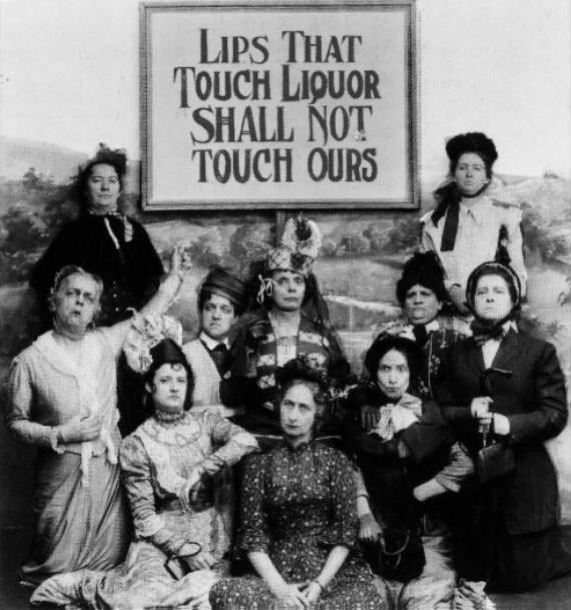
The international Temperance movement was one of the most powerful social movements of the 19th and early 20th centuries. Its advocates regarded alcohol as a social evil and sought to have it banned entirely, or at least its consumption drastically reduced.
Initially it was just a move against drinking spirits and “hard liquor”. But during Victorian times it became more a push for total abstinence and became more specifically a women’s movement, connected with Protestant Christianity. Groups of women activists were to be found right across the western world.


The Temperance movement had its most obvious success in America, where the sale of alcohol became illegal across the whole country overnight in 1920.

This period of American history has become known as ‘Prohibition”, the Roaring Twenties. It conjures up images of gangsters, speak easies and moonshine. The law did not have the support of much of the population. But it wasn’t until 1933 that it was finally repealed.
In Australia the temperance movement did not succeed in having the ‘demon drink’ banned but it did lobby vigorously for restriction of hotel opening hours. By 1923, hotel opening hours were restricted in all states. The closing of hotels at 6.00 PM led to a phenomenon known as the ‘Six O’clock Swill’.
It is hard to believe looking back that the daily rush to the bar was part of everyday life. Rather than limit drunkenness it actually encouraged it, as men who ‘knocked off’ work at 5 o’clock had only on hour in which to drink. Hotels were set up to serve as many beers as were demanded in this hour. Pubs were overcrowded, as men five or six deep lined the bar waiting to be served and patrons spilled out into the streets.

Pubs did smell strongly of beer as so much was served in such a short time. Sue can remember walking past Young and Jacksons on her way home and pushing her way through the throng of men, spilling out onto the pavement on the corner of Flinders Street and Swanston Street. Men, yes only men! Women were not permitted in the Bar until the early 1960s and for many years after that it was frowned upon. We can remember conversation stopping momentarily when we first walked into a bar particularly in the country.
The Demon Drink indeed! We come from a long line of teetotallers: our great grandfather Reverent Alfred Coates, our great aunt Sister Bessie, our maternal grandparents, Alfred and Alfreda, their siblings and our parents. Our mother’s family, the Coates, being staunchly Methodist, we imagine would have been very sympathetic to the temperance agenda. Here is Alfred, in his Methodist pastor uniform with Emma and their daughter:

We were very aware as children that none of our family touched alcohol and that particularly frowned on by our rather upright Grandfather.
We too, at the tender age of eleven of twelve, have had our brush with The Independent Order of Rechabites, who provide educational material for Victorian Schools.
Alice and Marge as old ladies recounted their childhood memories of drunkenness, in the country town of Croydon during the 1930s, with obvious disapproval and distaste. Here they discuss the public drunkenness they witnessed at the hotel and wine hall near their house:
Listening room
The Demon Drink — audio recording
Transcript
So now we'll talk about that wine hall and hotel. The wine hall they never use the word wine hall now, and it seems to have connotations of almost the early history. And in fact it was a very old building with a wooden veranda that came right onto the street. It looked more like a house didn't it? It was on one side of the corner of Main Street and Hewish Road, and the other, the two storied brick hotel. Now we didn't often see people in the wine hall, but the hotel always had people, men, always men, going in and out. And the men coming out, often fairly inebriated, with the smell of beer. And we realised that this was in the 30s and in the Depression; we realised that drunkenness in public was a much more common thing then than it is now. So much for the good old days.
Yes, and at night more than once I can remember our father having to get up and take home a moaning man who was lying in the grass behind the wine hall. And we remember drunk men in the lane behind the hotel. It was really a most unsavoury business. And the woman who used to scream In the lock up, because the policeman's house and the lock up were in the next street, and we could hear this woman often at night. So that was, for me, that was quite an important aspect of life in Croydon, perhaps because I always did the messages and had to go past it. But there was very heavy drinking. Yes.
I remember our aunt having a glass of beer at the dinner table, when we were staying there as children. I commented on it and I remember being rebuked. Later our mother told me that it was medicinal, that she had found that drinking beer with food helped her digestion. That mum had felt the need to explain it that way, and that our aunt had reacted so strongly to a child’s interest is understandable in the light of heir own childhood experiences and family attitudes.
And then, during our late teens, as the 1960s became the 1970s, this part of our past just melted away. It became normal and natural too open a bottle of wine to share. There was binge drinking around us, especially at Uni parties, and the drink driving hazard was evident, but the moral dimension, the “holier than thou” attitudes, the raised eyebrow were all gone. Society had grown up about the same time that we did.
.