Our mother’s and aunt’s formative years were spent in Croydon. Alice was six and Marge nine when they moved. They remember the seven years at Croydon as very happy, despite the shortage of money.Their parents worked very hard but also had stimulating and interesting friends. Alice and Marge attended a very progressive school and also had many playmates. Not only are their recollections of interest in terms of family history, but because they paint such a vivid picture of everyday life, so different from ours today.
When the Coates family moved to Croydon it was the beginning of the Great Depression and many men were out of work. To complicate matters, Alf had been in partnership in a hardware business in Bacchus Marsh that had burnt down. Not only was the fire a personally traumatic experience for the family, as their house had also burnt down, but the business was not insured. As manager, Alf was responsible for the lack of insurance. He was therefore “lucky indeed” to have the job as the hardware store manager at the Croydon Timber Yard. He was on a reduced salary as recompense for the losses of the other Bacchus Marsh partners, who now owned the Croydon business.
Croydon was at that time a pretty, country town, connected to the world by the railway that ran, as it does now, from Flinders Street to Lilydale.
White settlement had reached Croydon in the 1850’s, as timber cutters arrived seeking new sources of timber for the needs of rapidly expanding Melbourne. Many small, and a few large land holdings were taken up, and fruit trees were found to flourish in the area.

The town that the Coates family found, spread out from the railway station. Businesses and shops were strung out along the long, wide, slightly curving main street. The Dandenong Ranges made a lovely backdrop to the town that was surrounded by small farms, orchards and bushland. Home for the Coates was a small house, painted battleship grey, in Hewish Road, very near the corner of Main Street. This was the wrong side of the tracks. The expensive houses were built over the railway line in Wicklow Avenue, extending up the hill towards what is now Maroondah Highway.
They remember their house as having a beautiful backyard, graced by an enormous Mulberry tree and a large vegetable garden. There was a cow paddock on one side of the house and the Wine Hall on the other. Hewish Road at that time was unmade, covered in hard stone embedded in the clay. The Coates were right in the business end of town: Cook’s Grain Store was directly opposite and Croydon Timber Yard, not far away, also in Hewish Road. Not only did this fiercely teetotal family live next to the Wine Hall located on Main Street corner, but on the other corner was the Croydon Hotel. These two establishments loom large in their childhood memories, as they were the source of the moaning drunken men that they sometimes heard outside. Occasionally their father had to take the men home.
Croydon Hotel:

Croydon Wine Hall:

Alf worked weekdays, Friday nights and Saturday mornings at the timber yard. Once a month he also drove the truck to the wharves to collect timber.
Money was tight, especially as Alf and Alfreda wanted their girls to have a decent secondary education at MacRobertson Girls’ High School in Albert Park. One-third of Alf’s wage went on rent and by the time bills were paid and weekly expenses were covered, there was not much left over. At secondary school, fees were charged, books and uniforms would need to be purchased and weekly train fares paid for. Daily life therefore included the care of livestock and the processing of milk and eggs: all quite time consuming.

Listening room
The Croydon Years — audio recording 1
Transcript
He was lucky indeed to get a job at all. The depression had begun in earnest and people were hungry. Over the next few years our parents dug their heels in. Half grew vegetables of magnificent quality in the black earth. Again a drained swamp. We acquired a beautiful Jersey cow called Pet. She had a lovely face and she gave the richest milk. We made butter and sold some also cream. We gave away skim milk to people who brought billies to our back door. We later bought 200 day old chickens and reared them to adulthood. Then we sold eggs to the organization which eventually turned into the Egg Board.
Do you remember how we used to have to wash and test all the eggs for cracks? And this was this was often my duty. Did you do that at all? Oh I think so when I wasn't getting the door clock. That's right. And they had to be washed in cold water, often on a cold winter's day, in the laundry truck. I remember you, the wash house truck. I remember you feeding them with their mash in the morning. I used to do that in the morning. Pollard and bran and pollard and bran and a great big dish and pour a kettle of hot water into it.
As well as their home grown vegetables and fresh eggs, the Coates family produced their own milk and cream.
Listening room
The Croydon Years — audio recording 2
Transcript
And then there was the work with the cow. Oh yes. The milk. Twice a day the big bucket of milk would come in. Daddy milk of course. Yes, and we weren't allowed to touch the cow. And the milk would be put in these great big flat dishes and put on the one fire stove to set. The cream would come to the top and set on the top very slowly. And then the dishes would be put into a cool guardy safe, Which was down the three steps out in the furry. Yes, and the system was that the safe, which was made of wire and tession, was sitting between two trays, One on top with water in it. And strips of flannel hanging down to wet the sides. And collected in a tray at the bottom. And that was one of the best coolers. That's an Australian invention, isn't it? Cool guardy safe. It had to be in a draft, of course. Yes. And always outside. That's why it was outside. Yes, so the cream would rise. It had already risen, but it would set firmly. And then there was a skimmer with holes in it. A flat metal skimmer with holes in it. And one of us, Alice or myself, or sometimes our mother, would run that under the cream and lift the cream, big lumps of cream, off the skim milk and put it in a plate. It was absolutely luscious. We used to have it on bread. No, it was only some of it we ate as cream. The rest was made into butter. Which meant hours and hours and hours of stirring. Stirring, yes. I've still got the dish. Have you? At home, yes. We used to make butter. Well, the process was to stir it until the butterfat separated out from what was in fact buttermilk. Yes. Buttermilk, that's right, which we could drink. And then it was washed time and time again. Washed and washed and patted and patted. With the wooden butterpads. Squeezed, yes. And then a bit of salt was added and then it was patted up and all the water got out of it by patting it, the butterpads. That's right. It was a bright golden colour. And we ate it. Yes. And if we had a bit of factory butter we thought that was pretty good. We thought the factory butter was better. But then the milk that was left over was skim milk and that's what you referred to before about people coming for it and buying butter too. Sometimes they bought butter and sometimes cream. But Mummy used to give them the skim milk, feeling I remember she felt a bit guilty because she even had that more than a lot of other people. Yes. That's right. So that's the story.
But the reason that they kept the fowls and the cow really was, as far as I remember, in order that they could afford to send you to Melbourne to high school. Because on the money Daddy was earning there wasn't enough for that. Even for the train fares. Train fares, uniform. Books and fees. Yes, because prior to school there was a very low fee. Three pounds a term. But that was three pounds was. Was about as much as Daddy would have earned in a week.
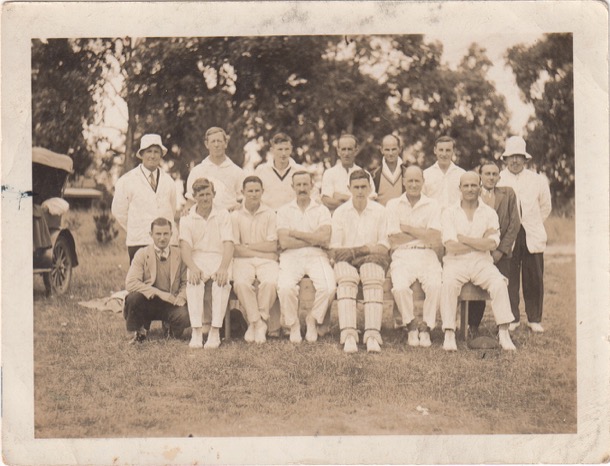
All was not hard work however, and the Coates’ kitchen, warmed by the one-fire stove, was the venue for cups of tea and chats, many of them about cricket. In the picture, Alf is second from the top left:

Listening room
The Croydon Years — audio recording 3
Transcript
But all was not hardship and sorrow. Croydon was a delightful country town in those days, with a mixed population from intellectuals to road menders. There were small town businesses and city commuters, for the electric train had gone through in 1924. There was a core of old families too, which had been there since the township had emerged out of the swamp. There was a magnificent hill called Wicklow Hill, covered with magnificent houses and people who kept themselves strictly apart from the town. We were divided from them by the railway line. Wrong side of the track. Alf was popular and met everybody in his job. Around our kitchen fire, seated on our straight back kitchen chairs, could often be found a mixture of men, from Mr Cheong, the local wealthy landowner, to Westy, the news agent, Mr Westcott, Mr Westcott. To Ben Hall, the, what did Ben do? I don't know. I don't know. We don't know. All were cricketers. Mr Cowley, the grocer. Oh, Cowley, that's right. Alice, you tell about the cricket. Oh, cricket, yes. Well, of course, as always in Daddy's life, yes, cricket.
He played with the Croydon 11. And later on, not long before we left Croydon, he was a bit old for playing in the first 11. And he, in fact, captained a team of young teenage boys. But those Saturday afternoons, again, after his hard work on the Saturday morning, he'd come home to a roast dinner. Mummy always made a roast dinner at midday on Saturday after her morning's cooking. And he would change into his cricket clothes, which would have been a white silk shirt and cotton trousers. And he wouldn't wear a belt. He tied a tie around his waist. Oh, did he? Well, this is the sort of person Daddy was, that he wouldn't, as he always wore boots to the end of his days, he wouldn't wear shoes. And he wouldn't wear wristwatches. Nor short socks. No, right. And that was probably because, as a child, he'd felt that he had to live up to the tough masculine image. And it lasted all his life. So, anyway, he'd tie this tie around his middle. Cricket boots that were cleaned with white. They'd be canvas boots. And black socks. Again, he wouldn't wear white socks. And the cricket cap, which I think was green. And I always accompanied him. And I can remember with great delight my afternoon cricket with that team. And I loved to watch Daddy bowling. And I loved to watch him batting at the end of the innings, with his high, wide and handsome hitting. And, in fact, I was the team mascot, because I used to go everywhere with them. And when we went to the neighboring townships to play, we went in the back of a truck. And I was there with all these men. I don't remember many other children going. But I certainly did. You were always there. Yes, I loved it. I went quite often, but not as often as you did. The best thing about the cricket to me was the afternoon tea. Yes, well, of course, that would have been especially at final on days of semifinals and finals. And I remember going to East Ringwood. And we got a photo of ourselves at East Ringwood one year. And the ladies used to set out a sit down lunch then at the back of the pavilion. Very sumptuous meal, with cold meat and salads and cakes. Beautiful stuff. Yes. So that was cricket with Daddy. And, of course, he had played cricket in Bacchus Marsh with the Bacchus Marsh team. And, in fact, had played in what was called, and I think still is, Country Cricket Week, when some of the significant teams of the country come down to Melbourne and play. In the city. And he got to play on the Richmond cricket ground, but never on the Melbourne cricket ground, simply because they weren't a lot of that. His team didn't happen to be a lot of that ground to play on. But I must put in here, before we leave cricket, I must put in the fact that I first went to the Melbourne cricket ground with him, well before I was 12, I'd say. And I can remember my first vision, and vision it was, of the Melbourne cricket ground, with the stands all around and the huge green arena and the white clad cricketers. It was magic. And that was before the big southern stand was built. That was before 1937. And there were elm trees along there then. But I think, on more than one occasion, I went with Daddy on the day after Christmas Day, on Boxing Day, And we used to sit, he used to get there early and sit right at the fence, right behind the wicket. And we'd sit there all day. And he never missed a ball. And now and again he would buy me an ice cream from the boys who came around with the trays of ice creams and lollies. And we would have our chicken sandwiches and cold plum pudding left over from the Christmas Day dinner. And he'd have his thermos of tea, and I would be bought a fruit drink. And, to me, they were quite magic, those days. That's where I developed my love of cricket at all. So at Croydon I used to go around with the team, with all those men. White headed girl.
Marge and Alice had a very happy childhood in Croydon. They played often with the Cook sisters, Yvonne and Margaret, who lived opposite. The Cooks had once owned the Croydon Timber Company, Alf’s employer.
Their house was on the other side of Hewish Road, next to the hotel. Connected to the Cook’s house was the grain store, which was now the core of Mr Cook’s business. There were delivery horses in a nearby stable too, and cows in the paddocks behind. The grain store was packed with bags of chaff and grain. The girls spent many hours playing in there, climbing right up to the roof.
One happy memory is of “penny concerts”. Hours of preparation: planning, costume making, and rehearsing, culminated in a concert performed on the Cook’s wide side verandah. This seemed to be mostly in the summer holidays, when the Cook girls’ cousins came to stay. Marge and Alice sang part songs, often Elizabethan madrigals they had learnt at school: Alice singing soprano and Marge, alto. The adult audience (probably only their parents) paid a penny to attend.
Alice remembered playing a sort of scavenger hunt, following written clues to find a prize. “Next clue under the camellia bush”.
She also remembered marbles, played in the dirt on the side of the unmade Hewish Road. When Sue and I stood on the same spot in our Croydon visit, we could hardly cross Hewish Road, for traffic! In the 1930s, it was a quiet gravel road with no gutters and unmade footpaths.
The Coates and Cooks lived opposite each other, and used to signal out of windows at night across Hewish Road. They planned, but never carried out, midnight feasts.
The wild games and excitement of playing with the Cook contrasted with the much more demure and restrained Hebbard girls. Pam and Honor Hebbard were the daughters of Frank Hebbard, the Primary School Principal, and friend of Alf and Freda. Their huge library of books were available for Marge and Alice to borrow, and the garden was a delight to play in. The Hebbards lived up on the Hill, at the top of Kent Avenue, which wound up to what is now the Maroondah Highway, through foothills bushland. A favourite activity with the Hebbards was to wander this bushland looking for native orchids. The remnants of this forest are much prized today, though much of it is degraded, and many of the species of orchid are now only to be seem in a museum.
Visits to the beach, during Marge and Alice’s Croydon years, were limited to School and Sunday School picnics. But they did learn to swim. They would go by train to Lilydale, where there was a huge concrete tank, right on the side of the Olinda Creek. Fresh water would flow in and out with this quite large perennial creek. Alice remembered Mr Hebbard lining them all up along the side and getting them to enter the water with a shallow dive. Nowadays the pool has become a more modern outdoor pool, but it’s still in much the same place.
Friday night shopping was another form of fun. Marge recalled it as a chance for everyone to parade up and down the street. Alice remembered buying “sixpennorth” of lollies and sharing them out. It was a simple life for these country kids. It is notable that, three years apart in age, much of their leisure time was spent playing together.
Marge and Alice of course went to Primary School during these years at Croydon, Marge as far as Grade 8. We will spend more time on this important topic at a later date. Suffice to say, at the moment, that their parents’ friend, Frank Hebbard was the Principal, and he ran a very enlightened, rich educational program, in which the girls flourished. The Croydon Primary School has new premises these days, but the old buildings are still there, now occupied by a Community School.
Family entertainment included hikes from Croydon to Kalorama, and visits to friends, the Cheongs. They were a wealthy and prominent family in the area. At our visit to the museum in Croydon we found many mentions of them, in particular their importance to conservation of remnant foothills vegetation. Even now Cheong Wildflower Reserve, near Croydon, still fulfils that role.
Mr Cheong, from our mother’s photo collection:

Listening room
The Croydon Years — audio recording 4
Transcript
Do you remember how we used to go for hikes along the ranges along Mount Dandenong? From Mount Dandenong to Fountry Gully sometimes we used to go. Not when we lived at Croydon. When we lived at Croydon we used to walk from home up to the top of Mount Dandenong. Is that what we did? Up to Kalorama. Sometimes up the face of the mountain. That's right. Yes, where it's steep. Yes, we used to do that. That was part of our entertainment.
And then another lovely memory was the afternoons we spent at Cheong's. Yes, we often used to go up on Sunday afternoon, didn't we? Yes, to their farm, and they'd first give us afternoon tea. Australian afternoon tea, it was. Chinese. They're brothers, and they lived in a big timber house with their sister. Above the railway line.
And we used to have a look at all their Chinese treasures, remember? The porcelain and the Chinese puzzles and things. And the carved balls within balls within balls. It was amazing. And then we'd go out, and there was sort of a ritual about it, wasn't there? We'd walk through their furnery, and we'd go and inspect their tennis court and see how well manicured the lawn was. And we'd go across and see their prized jersey ball and marvel at the depth that the posts had to be in the ground. I think it was six feet or something like that.
And then we'd walk through the bush. Do you remember how they'd call the bull over to the fence, and the bull would come charging up to the fence, prepared to rip the fence out of the ground? And then Ben would put his little finger in and put it through the ring through the bull's nose, and just lead the bull gently along the fence. The bull couldn't do anything. And then we used to go for a walk in the bush around about and get quite a lot of interesting orchids.
Because they had farmland, they must have reared cattle, beef cattle probably. And as well as that they had a lot of virgin bush. Virgin bush, and we used to collect some quite rare orchids. I remember once finding a mosquito orchid, those tiny little brown things. They had the most orchids out in Victoria outside the Grampian district. Did they? Yeah, but they were lovely people, weren't they?
In their leisure time, many happy hours were spent in the Coates’ warm kitchen, “yarning’.
Listening room
The Croydon Years — audio recording 5
Transcript
Going back to our kitchen, other friends came too, just dropped in, and the grey walled kitchen would ring with laughter, or reverberate to everyone's ideas on current politics, or sink its vibes to the mellow sound of what was known as yarning.
About cricket, often. Mostly about cricket. But there would be other yarns too, and much laughter.
Friends and relations came also from the city. Croydon was beautiful and an easy run for a 1930s car, and not too far away to go by train. There were always fresh scones and sponge cake and a great plate full of scalded cream and homemade butter and homemade jam. The table linen on the kitchen table was impeccable. It had to remain that way.
Even though much of the good food the Coates family ate was home grown, some things had to be purchased at the Main Street shops.
Listening room
The Croydon Years — audio recording 6
Transcript
You know we've been very keen on talking about the poverty of those days, but when you come to think of it, we ate an enormous amount of rich food, didn't we? We had bacon and eggs for breakfast. Every morning. Yes. Well, bacon and one egg, and we had cream and butter, and not all that much meat, though. One chop we'd had, and plenty of green vegetables, but lots of bread and scones and cake. I think we were pretty well overfed, and milk, of course, drinking a lot of milk. So I don't know whether that made us healthy or sluggish in the liver.
Of course I did the shopping. I think it must have been just about every day after school I went shopping to the grocers and the butchers and the green grocers, and I can remember that very vividly because especially when Mummy wasn't happy with the meat, and she always used to say, remember to ask for a short thick leg of lamb; it had to be exactly the right shape, the right amount of fat on it, and more than once, certainly more than once, I had to take that back to Mr Pretty the butcher because it wasn't good enough, and I would go with this big newspaper parcel under my arm and hang around outside the shop until it was empty so that I didn't have to face other customers with bringing back the meat.
And of course the grocer's shop and the Blartons and Miss Blartons, sighing when she had to cut the bacon, which she did by cranking a handle. She had arthritis or something, and we'd buy the bacon at half a pound a time so that we bought it quite often, and she always sighed when I asked for bacon.
But some of the prices, Jonathan Applesworth, threepence a pound, and threepence is about three cents, of course, and carrots, threepence a bunch, and I remember a pound of loin lamb chops was nine pence, which is under ten cents, not, of course, that that means anything in terms of today's prices, so it doesn't sound much, does it?
And the other thing about buying things, remember buying the lollies, remember going for a pennant of lollies? Yes. And the licorice blocks. Six licorice, big thick licorice blocks for a pennant. And then the choc toffs, which were candy covered chocolate, and the ingots, which were honeycomb, squares of honeycomb, covered in chocolate. They were lovely. They used to stand up in front of the display case. In the newsagents. But they were a lot better quality than the ones their kids bought.
The Croydon years were remembered very fondly by both Marge and Alice. They were formative years for both of them. Alice actually names the four areas of interest from those years that became her life long passions.
Listening room
The Croydon Years — audio recording 7
Transcript
We're just about at the end of the Croydon experience, but I can't leave it without talking about my knitting needle and orange, which I have thought of a lot since then, and I must have been— well, we left there when I was 13, so I was under 13, probably about 12, and I was standing in the doorway of the kitchen with, for some reason or other, a knitting needle and an orange, and I was thinking and poking this knitting needle into the orange, and I can remember thinking that— thinking really of the talks that our mother was constantly having, and as I poked the knitting needle into the orange I thought the problem is that people go past the center, and there is, instead of stopping at the center, which is real truth, they miss it; they go past it and, and by going through it and past it, not stopping there, they miss real truth. And of course this was a really a religious thought I was having, because what I was thinking about in terms of truth was was the essence of the nature of God.
So there was that experience, and also I was very, very aware of our father's sense of justice, and his his anger when he talked about the depression years, and the the fact, for instance, that some of the public works around Melbourne were built by men who were out of work, and they had had to do it in order to get a few shillings to to feed their families, and the utter injustice of work being done without paying full wages. Indignity. Yes, and also the injustice, also, by the way, the injustice of selling land— Of land that belonged to everybody shouldn't be for private sale— and those two aspects of my life, that came from my mother and my father, as quite a small child, stayed with me and colored my life, and and were important to me, and and still are.
In 1936 the Croydon years came to an end with the death of Martha Holm, Alfreda’s mother. Presumably the family had to move back to Boronia Street, Surrey Hills to help Alfreda’s sister, Berta take care of Roger Holm, now quite an elderly man. Berta was working full time at her dressmaking business. Alf found a new job in the city and Alice embarked on her secondary schooling at MacRobertson Girls’ High School.