

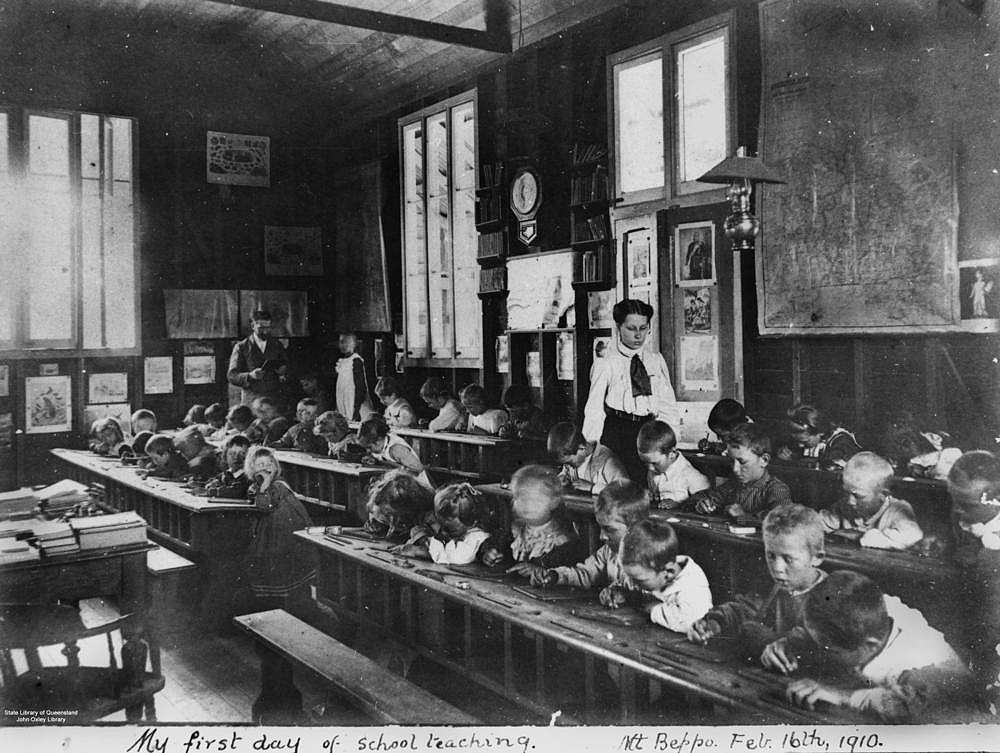
These children, photographed in 1910, are writing on slates with chalk, as did the children in our grandfather Alf’s classroom in 1909. The holes in the desk in front of each child hold inkwells, in which they dipped their pens. The little children are in the front, the older ones at the back.
Alice, our mother, described her father’s brief teaching career in 1909-10. The recording was made during the family history taping sessions with her sister Marge, in 1990.
Listening room
First Year Teaching 1909 — audio recording
Transcript
I can remember him saying that he started teaching at 14, but I think that must have been as an untrained teacher, perhaps like a what we call a teacher's aide today.
But he must have done some secondary subjects under the headmaster. And then he started actual teacher training again as a pupil teacher again underneath the headmaster. And I've got his criticism lesson book here from 1909. Now that would have been when he was 18, almost 19. And it was from the school at Katimatat. I think it was Katimatat. And then he didn't teach after that.

Alfred J. Coates
SS No 2069 (State School number)
Katamatite
Criticism Notes
1909
Class iii Reading
Class iv Proportion
Class iv, v and vi Invincible Armada
Class iv Comparison of Adj’s (adjectives)
Class ii Reading
Class v and vi Complex Sentence
Class iv Rivers
Class iii Reading
Class iii Drawing with Instruments
Class iv, v and vi Writing

Notes of a Lesson on “Composition”
Class vi 2:2:10
Essay Writing
Subject:- “A Farmyard”
1. Conversation on the subject.
Engage the class in a brisk talk about the subject, letting them relate what they know and have seen.
2. Divisions
Divide the subject into headings, viz :- Its buildings and their contents. Animals kept on a farm and their uses. Necessity of cleanliness, kindness, and suitable food. Work on the farm. The dairy and its contents; etc.
3. Farming the skeleton.
When this part of the subject has been settled, the facts appropriate to each division should be acquired. The information gained should be written on the B.B. (blackboard).
4. Clothing the skeleton
When the skeleton is completed, the essay should be orally composed by the children, point by point. When each point is accurately stated, it should be written on the B.B.
5. The written effort
The model essay is then turned and the children write the essay.

6. Correction
The correction may be made in part, while the composition is in progress, by the teacher passing behind the children; but the final correction should be made when the whole is completed. Mark mistakes in spelling, grammatical errors, and points omitted.
(Lesson critique by Headmaster)
Composition
Classes iv, v and vi, 2:2:10
(Teacher) Mr Coates questioned the scholars upon the subject “A Farmyard,” requesting what form such, and their several uses.
(Lesson) The subject was divided into various headings, such as – The buildings and their contents. The scholars stated the many things required to constitute a farmyard. Mr Coates wrote such on the B.B, and the scholars dictated the necessary work as written on the B.B., then they mentioned the many uses of each, and their several requirements, describing a dairy in a concise form, such as – “A Dairy is a

(Lesson) (continued) building containing milk utensils.” The description of a Farmyard was given in a condensed form by the class. The scholars wrote an exercise about the Farmyard for Composition under the supervision of Mr Coates.
(Class) The scholars took great interest in the lesson and gave full description of the subject. They had good ideas about such when Mr Coates tested them orally.
(Special) Mr Coates was very earnest with the lesson, and explained things to the scholars in a very careful and interesting manner.
JM
3/2/10

Alf 1910
Marge and Alice went on to discuss some other aspects of Alf’s early life.
Listening room
First Year Teaching 1909 — audio recording 2
Transcript
Alfred was the second child of Alfred and Emma Coates and was born in 1890 in South Melbourne during a flood, as we have previously mentioned. As his father was a Methodist parson, our father moved around a great deal during his childhood, always in the country. Some names we remind you are Talangata, Tangamah, Katamata, Chiltern, Alexandra, Campbell Field, and Diamond Creek. Yes, but he'd left home before they came down to Campbell Field and Alexandra and Diamond Creek. In those days, which were horse and buggy days, this was deep country indeed. There were a few small train lines here and there, but transport was few and far between, and there were no buses. The Victorian train lines radiated out from the central Melbourne and at their extremities. The distances were very big.
All his life Alfred never lost his love of the bush and used to long to return to it to the day he died. He liked especially the open plains, and yet he lived in the northeast. Alfred started school at three years of age. He showed signs of brilliance and was quickly pushed. The having been in an advanced class for his age, Alfred was bullied by the older and bigger boys, which included those Cornish miners sons who frightened him so much. He was red headed into the bargain, and somehow in those days this counted against him. Worse, after he had been in a fight with older boys, his mother Emma had thought it wise to discourage him and had given him a.
From our memory of the way our father used to talk, he had a particularly close relationship with his mother and a happy one with his father. He used to talk a lot about the things he used to do with his father, but somehow or other overall I feel some sort of a wistful sadness about his childhood, and it probably was because he was small in terms of his school life and his mother would have been a very busy woman, and, you know, we hear about him sitting out in the gutter in front of his house waiting for his mother to come home, and somehow or other that brings up some sort of feeling of sadness. But then, after he finished his school years, he coached boys for scholarships. Boys of his own age. Some of whom got high positions later.
However, he was not allowed to sit for a scholarship himself in case he got one and his father would have to pay for the board away from home. Later, his father bought many houses in St Kilda with his savings. Shortly after this our father got traumatic fever, which affected his heart, and this prevented him from being admitted into the army during the First World War, a thing which cost him further trouble.
More of Alf’s Teaching Notes are available in the Resources Page, which can be accessed from the Navigation Bar at the top of this website. If you are using a phone, or a tablet in portrait rather than landscape, click the tiny + under the logo and heading, to reveal the Navigation options. Our site is much better viewed on a computer or at least in landscape rather than portrait.