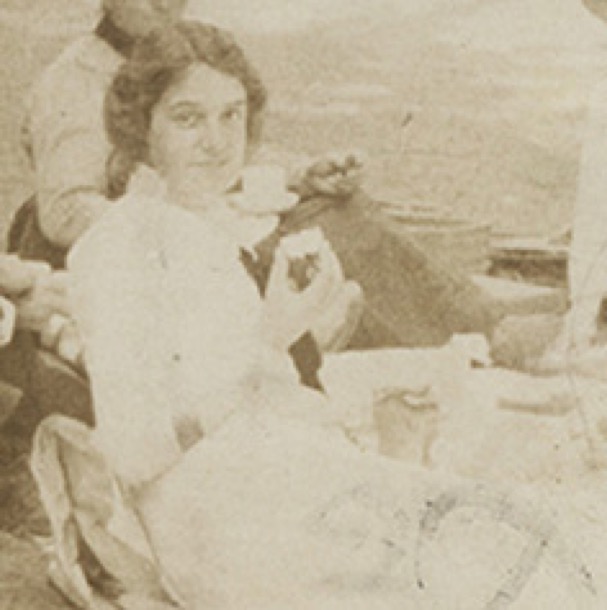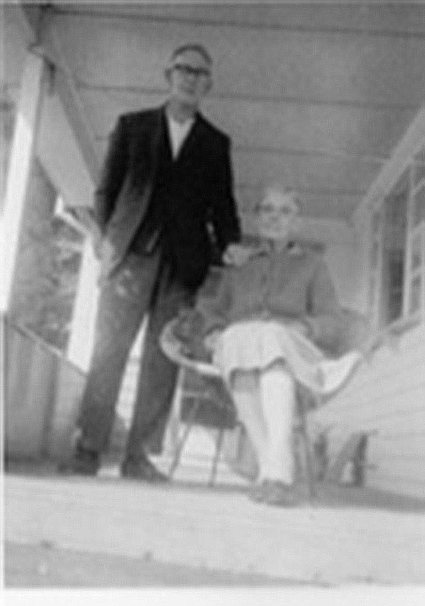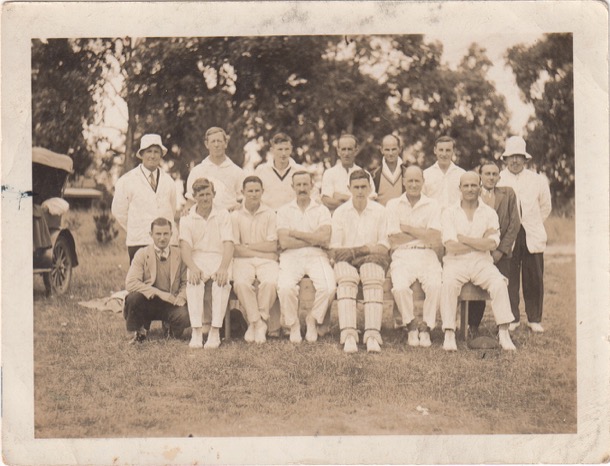
Alice and Marge in 1990, as they sat with their cassette recorder, told as much as they knew about their grandparents and great grandparents.
Like many Australian families, ours is a story of migration to a new country. All four of our maternal great great grandparents were European: English, German, Danish and Irish.
These four migration stories happened between the 1850s and 1870s. Three of the migrants were our great great grandparents, and one was a great grandparent.

COATES, ARRIVED VICTORIA 1860s
Listening room
Great Great Grandparents — audio recording 1
Transcript
Let us start with Coates our great grandparent whose first name we do not know He was an English cockney an engineer who came from London on a sailing ship in the 1860s He was one of a team who came from England with pieces of an iron bridge to be erected over the Bowen River somewhere near Geelong
He and his wife reared a family in a tent on the banks of the river His wife came out with him on the boat She wasn't born here either And we don't know how many children they had do we No The only one that I ever met was a man a brother of my grandfather The other boys a big family of boys I believe were lost to family history Their grandfather was called Alfred And he was born on the banks of the Bowen River And he didn't even know of his birth His birth was never registered
Coates was an English engineer who travelled with his wife to Australia in the 1860s. Their first names are not known.
The Barwon River is the large river than flows through Geelong. In the new colony, there were no iron works: the worked iron had to be imported from England, along with the experts to do the work.

Barwon Bridge then

Barwon Bridge now
We don’t know whether Mr and Mrs Coates planned to do this job and then return to England, but they would have found a thriving, wealthy colony. Gold had been discovered in central Victoria just ten years earlier.
DOW, ARRIVED VICTORIA 1860s
Listening room
Great Great Grandparents — audio recording 2
Transcript
Now, great grandfather Dow: we don't know his first name. He was a German immigrant who came to Australia from Bavaria. There is some evidence of a high class family, The Von Dows. His daughters were in touch with a family in Germany after the First World War. He was a widower of 40 odd when he married our great grandmother during the 1860s, so he was probably born about 1820. She was 15 when she was married. Her husband had picked her up in the Victoria Market and taken her home to Wollongong. Oh gosh, 15. A child. And he said picked her up. That's how the tale goes, and the imagination boggles at this: whether she was somebody selling fruit and vegetables there, or whether she was buying for her family, but a little girl of 15.
And then they had this journey back to Wong Dong, which is up near Kilmore, Wollongong, around that area, and obviously not a prosperous farm. And she had that long journey by cart or buggy or whatever from Melbourne to there with this middle aged man. We don't even know whether she was picked up and dragged off straightaway, or whether she'd known him for a while or what, but the picture's pretty hairy, isn't it? Yes, the picture is that she was. This poor little thing. And yet, that poor little thing, when she got back to this farm, which we presume is a pretty poverty stricken farm, and the little house with the earth floored kitchen and the cows, and I remember our parents telling us that she rolled up her sleeves and started milking cows straightaway, and then proceeded to have 18 children over a period of, I would say, not much more than 20 years. And during this whole time she was the one milking the cows and whatever other sort of farm work. And we have the story that he was a bit of a scholar, and he used to get out behind the shed and read and study the stars, and while this, we don't know her name, do we? No. But here she was, bearing children, doing farm work, and 18 children. And the first, I don't know, seven or eight or something, were girls. And before they had strong farm boys. And our grandmother was the third, I think, And she was born around 1870. So that we can only picture the sort of life they lived, And I think it must have been a pretty poor life without many amenities. And we assume it was a poor farm because the land is poor around there, isn't it? Yes. Pretty scrubby. In spite of, or because of, all this hard farming and childbearing and childrearing, she lived until she was over 90, and she had grown so broad in the beam that she had, when she was going somewhere by train, she had to be pushed through the carriage door. That's right. She was probably as broad as she was high. That's right. And he, Great Grandfather Dow, died on his 102nd birthday, in bed, sitting up and singing a hymn. Let's go back to the 18 children. We do not know all their names, but our grandmother Emma used to reel them all off. We were so overawed, however, by this performance, we lost count of the names after the first yaw. And that went: Sarah, Mary, Emma, Bella. And we raked up another seven names: Alice, Annie, Nance, Ethel, Wilfred, Arthur, Walter.
Dow was a German farmer who arrived in Australia in the 1860s. He married a fifteen year old girl, of whom we know very little. Wandong is 70 Kilometres north of Melbourne. In the years the Dows lived there there was a thriving timber industry and some gold mining. By 1880 there was a railway line from Melbourne.


Timber yard at Wandong, 1880
HOLM, ARRIVED ADELAIDE 1872
Listening room
Great Great Grandparents — audio recording 3
Transcript
Let us now take the other side of the family, the Holm Bell side. Up till now we have begun with great grandparents, but Roger Holm Rahy R A G H Y E, who arrived in Australia about 1872, was our grandparent. He was the son of a Danish farmer, whose status was not that of a peasant but a yeoman who owned his own land. And that farm was a dairy farm, I presume, because that part of the world is dairy country. I think they had everything. Yes, and Grandpa's mother must have been a thrifty woman, because she bought stale butter from surrounding farms and washed it and patted it up again and sold it. And then, of course, his sisters would have been well versed in domestic duties, and they went out to service, which means that they went out as servants to big family homes and apparently made quite good marriages. And we're not sure about how many other children there were, except that we do know that he had a brother who went to England, and we'll tell you about that in a minute. Yes, and the animals on the farm were kept under cover in the winter. And hand fed. And were hand fed, yes, and the children only went to school in the winter. In the summer they had to work all the winter. Oh, they only went to school in the winter. Yes, yes. So it would have been a typical northern European farm life.
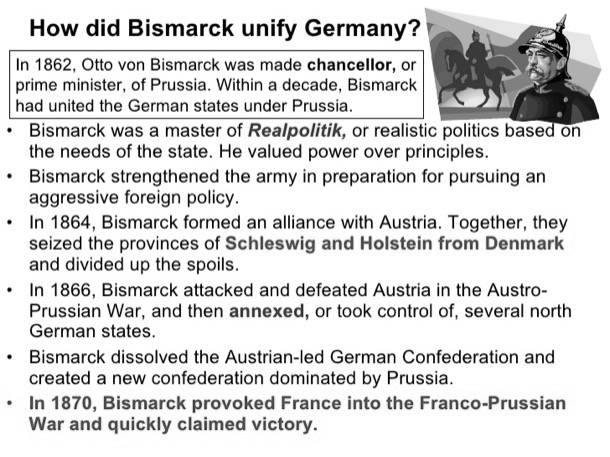
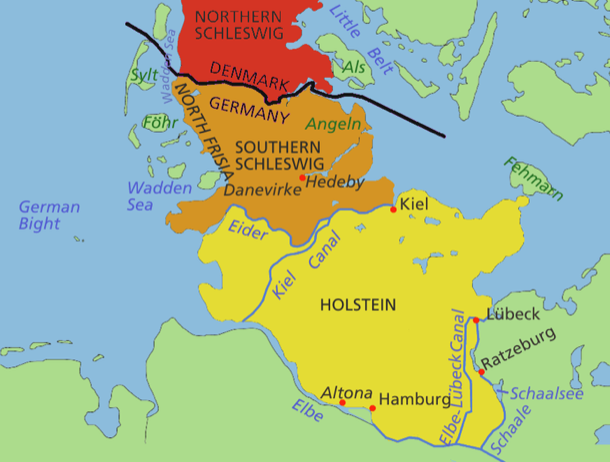
And that name Raythe that you mentioned before was Grandpa's first name, his Christian name, which he changed to Roger when he came here to Australia. And he was born on the 4th of February 1854. At the time of Roger's childhood, Bismarck had conquered Schleswig Holstein and exited to Germany, and ordered that the children speak only German in schools. Later Roger had to join the German army and was conscripted into the cavalry officer's training school because of his superior horsemanship. We do not know how long Roger remained in the army, but eventually he deserted and went to London to join his brother, who was teaching bakery at the Royal Naval College at Greenwich. That would have taken a lot of courage, wouldn't it? Because I guess had he been caught as a deserter he'd have been summarily shot. Yes, certainly. And he joined his brother and actually learned bakery himself. And then from London we don't know just when Roger migrated to Australia on one of the last regular sailing ships. He travelled via the Cape of Good Hope, and the journey took six months. Yes, yes. And the Suez Canal was already built, but I suppose that probably sailing ships didn't go through the Suez Canal. They'd have needed the open ocean for the wind, I suppose. He arrived in Adelaide and spent some time there. Then he travelled on to Melbourne, leaving his luggage, with family photos, etc, behind him. He had intended to go back there but never did. Instead, he married Martha Bell in Melbourne about 1888. He was about 34 when Martha was in her late 20s.
Roger Holm: this one is our great grandparent, a baker, who himself arrived in Australia from Denmark via England in 1872.
Roger had been born in a part of Denmark called Schleswig-Holstein, that had been disputed territory for centuries. At the time when he was a child, Germany did not yet exist. It was still a whole lot of little countries. When Roger was twelve, Otto Von Bismarck’s army invaded Schleswig-Holstein.

Map of Schleswig-Holstein

Otto Von Bismarck


Painting: Bismarck Wresting Schleswig Holstein From The Danes
BELL, ARRIVED VICTORIA 1850s
Listening room
Great Great Grandparents — audio recording 4
Transcript
Now we can once more begin with a great grandparent, an Irishman called David Bell. He was the father of Martha, our grandmother, and they were in Australia as early as the 1850s, during the gold rush. This time we also know something about his wife, whose surname was Elvidge, and we even know something about her parents too. Originally, David Bell was a flax farmer who lived near Belfast. We are told he made a runaway marriage with a daughter of the wealthy hotel owner Elvidge, who owned the biggest hotel in Belfast. It was called the George Inn. Apparently they entertained royalty, and our great grandmother reported having seen her mother at the top of the stairs, welcoming them as they came in. David, the flax farmer, apparently snatched a daughter of the Elvidges from the nursery when she was merely 18. Girls were educated then by governesses in the nursery until they made their debut, but her brothers went to school in England. David and his wife had two children before they travelled to Australia, but left them in Belfast and never returned to get them. This is to be continued on SARD 2.
After David's wife had had her 10th child she was weak and exhausted, and it seems she began to drink stout on the advice of a neighbour in order to get her strength back. Because they're becoming weak after having her eight children she wouldn't have been very much different from a lot of women who came out to Melbourne in the last century. Well bred and finely bred and a bit pampered at home, and Melbourne was a pretty tough place to live in in those days. So that, I suppose, that they lost their strength and their spirit, some of them. Eventually, David's wife became an alcoholic, and David put her in a home and took a housekeeper. He and the housekeeper proceeded to entertain Melbourne's high society on a grand scale, and eventually Mrs Lerish, which was the lady's name, absconded with a great deal of money. How she did it we are not told, but David's eight children were impoverished. Martha remembers being hungry, and this is unlikely to be an exaggeration. We have only the names of five of the ten children: Fred, David, Jim, Martha, and Margaret. Martha was called Matty, and Margaret was called Maggie. They were the last two children and were very close.
David and Martha Bell was an Irish flax farmer, who arrived in Australia with his wife Martha (born Martha Elvidge) in the 1850s. Belfast was a prosperous modern city at that time.

Belfast about 1850
The area had become a specialist for farming and processing flax, which was woven into linen, used among other things for ships’ sails.

Flax Farmers

Processing flax