

Our mother’s sister, Marge, who had been close to marrying an American Serviceman during the war, had had a whirlwind romance with George Rostos, a Hungarian Jew, who had emigrated to Australia during the war. His parents, who were later to join him and Marge in Australia, had been in a Nazi concentration camp. George and Marge were married in 1945, the year the war ended.

From left: Alice, George and Marge
Jim and Alice, our parents, were married later the same year. A busy year, as in October of that same year, George was offered a job in Sydney at the CSIRO. It was an exciting and welcome offer but it led to “a great family sorrow” as George and Marge moved to Sydney. They travelled to their new life on The Spirit of Progress, then a steam train.

The family gathering the night before. From left: George, Alice, Freda, Alf, Auntie Bert and Marge.
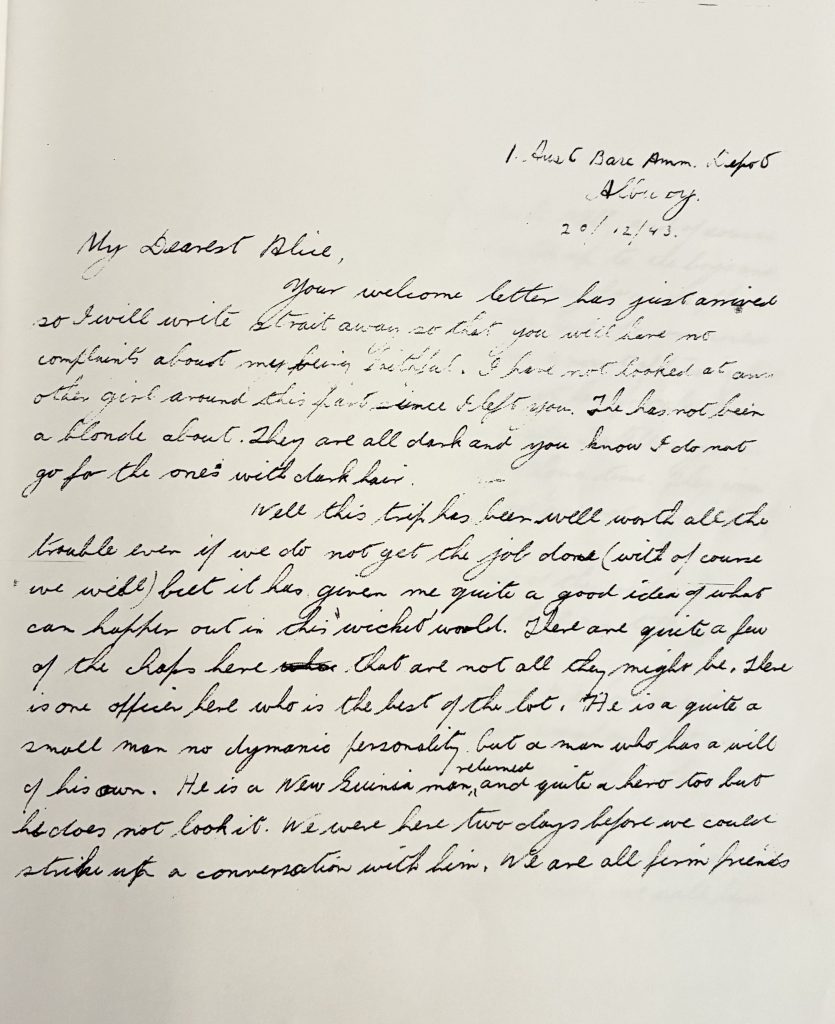
To us in the world of instant communication and Skype we may think, “What’s all the fuss about, it’s only Sydney?” But, in1945, five months after World War 2 ended, it was quite a different matter. During the war people had not travelled much, and even long distance train fares were expensive and airfares, prohibitive. Once the train pulled out of the station one of the few means of communication was by letter:

The only other means of communication was by telegram. Telegrams were expensive, as you paid per word, and therefore they were usually only used in emergency. You would take the message to the post office where it was translated into Morse Code, and then transmitted along telegraph wires, decoded at the other end and delivered to your home by the telegram boy on his bicycle.

LIFE IN SYDNEY
And so began their new life in Sydney. The first three places from 1945 to 1949 were all in fashionable, post-war, cosmopolitan Sydney.
Listening room
A Great Sorrow — audio recording 2
Transcript
Our first home was at Rose Bay, a good introduction. A friend of George from Budapest was living alone there, in a flat which belonged to his wife, who had left him. It overlooked the flying boat base in Rose Bay on one side and the Sydney Golf Links on the other.
Bondi offered us a bedroom there if I would cook the dinner; I would. The arrangement worked well. We were all good friends and enjoyed life thoroughly. I met lots of interesting people, mostly Jewish refugees from Europe, and for a while scarcely had an evening at home. Sydney was still pre war simplicity at the time and very seductive. I even forgot the terrible trouble I had caused my family. Eventually Bondi's wife wanted her flat back and we had to move.
Marge and George had only known each about a year when they moved to Sydney. Marge speaks of their friendship group in Sydney, including Bandi, with whom they lived, as Hungarian Jewish refugees. What an amazing new world she lived in! Rose Bay and Potts Point were, and still are, in the heart of fashionable Sydney.

Marge speaks of watching the flying boats landing at Rose Bay. It had been a busy “airport” during the war, and, in 1945, was still used for overseas travel.

POTTS POINT
Their exciting new life continued in another inner city apartment.
Listening room
A Great Sorrow — audio recording 3
Transcript
For us there followed a series of boarding houses and rented rooms which, though a drag, we took in our stride. We were free and young, and George started to earn a reasonable income, and we went everywhere. Then we found ourselves back with Bandi again, this time in Potts Point. The full rent of the flat was equal to half George's salary. We paid half each. It was a nice new flat, furnished and serviced. Potts Point and Kings Cross were wonderful places in those days, full of Europeans, artists, actors and actresses, and the like. Probably the first really cosmopolitan place in Australia. We breathed the air with rage. Bandi got a job as violinist with the New Sydney Symphony Orchestra, and we spent many Saturday mornings listening to them practising. I tried to get a job as a tracer, but the men were coming home from the war and filling the jobs. I then decided I would learn typing and shorthand, but it was a bad move. I spent nine months learning in a little business college opposite Windham Station, and though I enjoyed the life and the company of the students and roaming around Sydney City at lunchtime, I never got a job out of the exercise.
The day came when Bandi and we had to part. His mother and sister were coming from Hungary and would need accommodation. There was nothing for it but to move out and let him have the whole flat.

Potts Point is right on the harbour.
BELLEVUE HILL
Bellevue Hill, where Marge and George lived for three years from 1947, is in much the same area of Sydney.
Listening room
A Great Sorrow — audio recording 4
Transcript
Fortunately another friend had a one bedroom flat in Bellevue Hill which he let us have for three years at a much lower rent while he was away in India. It was there that Pauline was born in 1949. Before Pauline was born, before Susan was born in 1948, I stayed with you there for two or three weeks. Yes, yes.
In the meantime I had a couple of jobs for short periods, but neither was satisfactory. Things were pretty chaotic in Sydney at the time. People found it hard to get jobs unless they were ex servicemen, and rented flats and houses were almost unprocurable unless one could pay the enormous key money. Many people tried to start building, but often didn't get far before they came to a full stop through lack of materials or a builder who had squandered with the deposit. Jail builders flourished everywhere. Yes, there was a lot of shady practice going on then, wasn't there, especially in Sydney?
When our friend returned from India after three years, George and I and Pauline had to find another home. We also decided that we would have to face the job of bringing George's mother and father to Australia. Life was getting unbearable for our people in Hungary. They had been in a Nazi concentration camp during the war and now began to be fearful of the Russians. George would have to remain in Sydney and look for accommodation, and Pauline and I would go to Melbourne and stay at Brony Street.
They shared this flat with Phyllis, who seems to have worked in a job where she had access to otherwise unobtainable items. Marge speaks of her often in her letters.
These two extracts are from letters Marge wrote to Alice from Bellevue Hill, in 1947:
We, George, Phyllis and I, went to the beach (Tamarama) yesterday. Phyllis got let down by one of her blokes whom she had quite a crush on and she came with us. I must admit she took it with great dignity and amusement, though I know she was a bit crushed. So we sunned from 11 o’clock till 3. George and Phyll went nicely pink, but I did not change from my pale putty.
The job is still quite within my scope. i mean the two jobs. Phyllis helps a lot and, even if she is not home for dinner, never neglects to make us a delicious sweet from her American Cookery Book and peel some veggies for me.
She helps in many small ways which are not noticeable too, and I often go to do a small job to find it is already done. She brings lots of things from the planes – fruit and soap and face tissues; and brings me Persil (laundry powder) and Lux (toilet soap) and Velvet Soap (used for washing dishes, floors, surfaces, hand washing clothes etc), which have been unobtainable here for months.
This one was written acknowledging a birthday present:
I am so terribly thrilled with the cloth. When i first opened it I thought you must have got cloth at some art shop with stamped design and spoked hem and advised colours, but on reading your letter I find it is all a family affair and I am truly amazed and pleased with your taste and industry. Did you really do that spoked edge all on your own? I just love the colours, especially as my favourite colour is yellow. Thank you darling so very much. I shall cherish it and wash it so carefully and it will only be used on very special occasions. Tait also gave me a cloth – a beige one, very tasteful and good material. She also gave me a coffee pot to go with my set. Stephen left me a beautiful round cloth in Hungarian lace too, so i am not so badly off now. Phyll bought me a butter knife, a rolling pin and a beautiful round crystal bowl with two little handles and that engraved work around the sides- grape design and I love using it. I am now serving up my meals continental fashion these days, piling everything on dishes in pretty patterns and let the folks serve themselves. – It’s fun…..
…….if George were Australian I would certainly encourage him to take a job in Melbourne, but good jobs for foreigners don’t grow on gooseberry bushes. Here is an example: Last week Knox Schlapp advertised for a clerk. Several people called and one among them with a German name. I announced him to Mr Shaw who said to me, “That’s a foreign name. Is he a foreigner? I don’t want to see him.” I had to go and tell the chap to go away, and he had by far the most intelligent face of all that we interviewed. (Mr Shaw doesn’t know that George is a foreigner) They are turned down before even given the chance. Then again, George is not treated as a foreigner out there (CSIRO). In the atmosphere of prize scientific research, which exists there, such things do not matter and he is gaining the confidence and poise which he certainly would not out in the industry and commercial field.
SEVEN HILLS
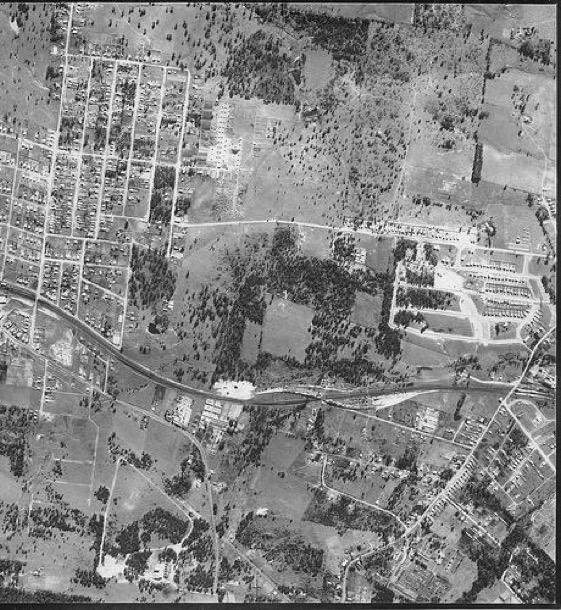
Life was to change dramatically for Marge and George when they moved out of fashionable, lively Sydney into a house in a newly developed housing estate at Seven Hills, 37 kilometres west of the city.
Listening room
A Great Sorrow — audio recording 5
Transcript
Yes, so you were down north? It was nine months ago when we left Georgia, 15 months when we reunited in a housing commission house, which we won in a ballot in Seven Hills. Marge, that was over Seven Hills. What was the name of the street? Second Avenue.
And that says something, because Seven Hills, of course, it was part way to the Blue Mountains, out beyond Parramatta, and it had been just open country. And then they suddenly put in this suburb of housing commission houses on this grid of streets. A grid. Yes, and sort of just artificially all built there at one time. And the houses weren't as good as the housing commission houses here, were they? No, no, very fragile. And it was drab. Yes, and there was no shopping centre, there was one country store, there was no transport, there was a steam train, and there was no doctor, no chemist, no doctor.
Because I stayed with you for a while with Susan. Yes. When she was little, I can remember her in our backyard. But it wasn't a good time, and it was very different from Rose Bay and Bellevue Hill and Passpoint. I mean, it was difficult for them. Yes, it was very bad. Well, we didn't mind it so much. We got a car when we lived there, an old car, a 1927 Chev, a big square jack.

Seven Hills Estate in 1945.
It was not until the mid 1950s that George finally got a job in Melbourne CSRIO, and they all moved back to live close to their family.