We remember little of our maternal grandmother as a person. She was rather a remote figure, tall, elegant, well dressed but she appeared to us to have little interest in her grandchildren as individuals.
We have been able, after carefully listening to the tapes, to piece together a portrait of a very interesting woman, deprived of the further education she craved because of gender and circumstance.
Listening room
Alfreda Maria Holm, our maternal grandmother: the first seventeen years — audio recording 1
Transcript
We now go on to our mother's life before she was married. Alfreda Maria Holm was a second child of Martha and Roger Holm, their first child, Dorothy, having died, as we have told you. Alfreda was born on the 26th of September, 1892, and grew into a dark, beautiful girl.
Before you go on to that, her mother was 28 at that age, and I think earlier you had said that her mother was 28 when she married, but in fact she was 24. She was, in fact, 10 years younger. Nana Holm was 10 years younger than Grandpa Holm. So she was 28 when mummy was born. That's right. Right. She grew into a dark, beautiful girl, very serious, yet very vivacious. As a child she lived with her family mostly in the St Kilda area, the only two addresses we know being the old Raglan Street family house, which her grandfather had built, and the Terrace House in Inkerman Street.
Alfreda’s maternal grandparents, David and Martha Bell, emigrated to Melbourne from Belfast. Her mother, also Martha, known as Matty, was their second last child. Alfreda’s father, Roger emigrated about the same time from Denmark. He was a baker and Matty ran his baker’s shop in St Kilda where they lived during Alfreda’s childhood.
Our previous, post published on 18/11/15, entitled “Great, Great Grandparents” is full of detail about Alfreda’s grandparents.

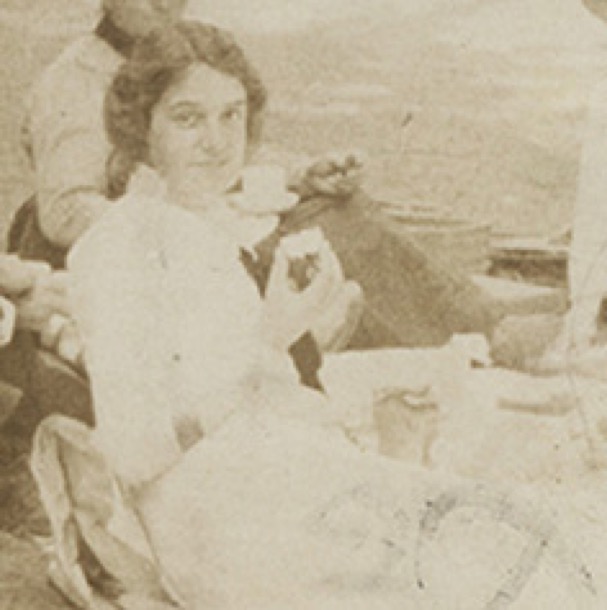
The few photos we have of Alfreda as a young woman, come from an unlabelled, unannotated photo album we found among our mother, Alice’s photo collection. I remember her showing it to us, but unfortunately, the only part of that conversation I remember is the fact that the childishly scrawled number on each photos were written by Alice, indicating the number of people in each photo. This might have been the first time I had contemplated the fact that my mother had once been a child.

Alfreda Maria, dark and vivacious yearned for an education. This bewildered her family, as further education for its own sake, beyond that required for employment, was not known on either side of the family.
Listening room
Alfreda Maria Holm, our maternal grandmother: the first seventeen years — audio recording 2
Transcript
Now as she grew from childhood, Freda developed a strange desire to be educated, an unheard of yearning in any of the family on both sides, though many of the Dow's got there somehow. The Dow's wanted vacations, but this was not what Freda wanted. She wanted to be educated, to go on, as she used to call it. That was a very different thing. Eventually, at what age we are not sure, she got herself— no one else would have— into the old continuation school, the forerunner of the Melbourne High School, To the bewilderment of her family, none of whom could be pressed under any circumstances to set foot in a school past the compulsory age of Grade 8.
And that school, the old continuation school, was in fact a teacher training school. Yes. For state school teachers. Yes, it was the first. There were boys as well as girls at the old continuation school, and Freda was competitive, ambitious; she was good at maths and vied with the boys for top place. We get a picture of her in her school uniform: a flared skirt nearly to the ankles, boots below, a tight waist, and a white blouse with a high lace collar, a straw sail hat. She wore her sleek black hair long and tied behind with a ribbon. She was beautiful, and we got the impression that nothing would stop her; but it did.
Freda was high spirited and curious, and loved learning all her life, but she was severely hampered by her sex and by poverty. Still, she never lost her enthusiasm for a new idea or the opportunity to study a notion in depth. Eagerness and alertness were probably the key note of her temperament, but she was inclined to be spoiled and had a tendency to be a primadonna.

Alfreda would have worn an outfit similar to this to school
As Alfreda’s parents could not afford private school education the only secondary school available in Victoria for her to continue her education after Grade 8 was the Melbourne Continuation School. Luckily, the Continuation School was established in 1905, just in time for Alfreda.
It is to her credit that this determined, fifteen year old girl living in Edwardian Melbourne was able to pursue her dream of further education and find an opening for herself. Handicapped by her gender and lack of interest from her family, she was successful, and loved competing with the boys for top marks in Mathematics classes. She would also have had to do cookery classes: considered an essential element in a girl’s education.

At Melbourne Continuation School
The opening of the co-educational and secular Melbourne Continuation School marked the beginning of state secondary education in Victoria.
The site chosen for the school was at the top of Spring Street, now occupied by the Royal College of Surgeons.

The building in the centre of this photo is the Continuation School. On the skyline is the Royal Exhibition Building.
In 1905 the Continuation School offered a two year teacher preparation course to pupils aged 14 years and above. It also provided tuition, enabling students to sit for university entrance exams. Unfortunately this was not an option for Alfreda and so, after two years further education, she began her teaching career.
In 1914, long after Alfreda had left, the old Continuation School became so overcrowded that a solution needed to be found. Consequently Melbourne Boys High was established for the boys and for the girls: MacRobertson’s Girls High School. Both of Alfreda’s daughters, Alice and Marge, were to attend this school for their secondary education.